SISFS Explained: Who Qualifies and How Much Is Realistic
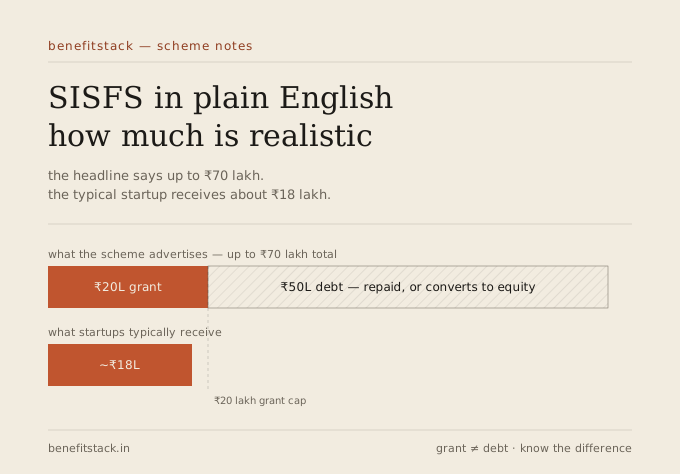
The headline says up to ₹70 lakh. The typical startup receives about ₹18 lakh. An honest breakdown of who qualifies, what the money actually is, and when to apply.
By BenefitStack Team
The Startup India Seed Fund Scheme — SISFS — is a Central government scheme, launched in April 2021 by DPIIT, with a corpus of ₹945 crore. It was designed to give early-stage startups capital at the point where private money is hardest to raise: before you have revenue, traction, or anything a bank or VC will underwrite.
It is meant to fund roughly 3,600 startups over its life, channelled through more than 300 government-recognised incubators across the country. As of December 2024, it had disbursed about ₹467.75 crore to over 2,600 startups, including more than 1,200 women-led companies.
That's the official description. The more useful thing to understand is what those numbers mean for you.
The number that actually matters
The scheme is usually described by its headline figure: "up to ₹20 lakh as a grant, and up to ₹50 lakh for scaling." That is true, and it is also misleading, because it bundles together two very different things.
Of the roughly ₹468 crore disbursed to 2,600+ startups as of end 2024, the average works out to about ₹18 lakh per startup. That number is close to the ₹20 lakh grant cap — which tells you something important: most funded startups are receiving grant-side support, not the larger ₹50 lakh figure.
If you're modelling what SISFS could realistically mean for your company, the honest planning number is closer to ₹15–20 lakh, not ₹70 lakh. The ₹50 lakh exists, but it's the exception, it comes later in a company's life, and — as we'll get to — it isn't a grant at all.
Grant vs debt: the distinction founders miss
SISFS has two components, and they are not the same kind of money.
The first is up to ₹20 lakh as a grant — for validating a proof of concept, building a prototype, or running product trials. A grant is non-dilutive and you do not repay it. This is the part most founders are actually eligible for and actually receive. The catch is that it's disbursed in milestone-based instalments, not as a lump sum. You don't get ₹20 lakh in your account on day one; you receive tranches against deliverables you agree with your incubator.
The second is up to ₹50 lakh for market entry, commercialisation, or scaling — and this is where founders get caught out. This money is provided through convertible debentures, debt, or debt-linked instruments. In plain terms: it either has to be repaid, or it converts into equity in your company. It is not free money. It's closer to a structured early loan or a small convertible note from the government than to a grant.
If someone tells you SISFS gives startups "up to ₹70 lakh," they're adding a ₹20 lakh grant to a ₹50 lakh debt instrument and presenting the total as if it were all free capital. It isn't. Treat the grant and the debt as two separate decisions.
Who actually qualifies
The formal eligibility criteria are short. The reasons founders get rejected — or never get to apply — are usually the criteria they didn't read carefully.
To be eligible, a startup must:
Be recognised by DPIIT. This is a prerequisite, and it's a separate registration process you complete before you can apply. If you're not DPIIT-recognised yet, that's step zero, not step one.
Be incorporated not more than two years ago at the time of application. This is the single most common silent disqualifier. SISFS is for genuinely early-stage companies. Founders frequently hear about the scheme in year three or four — by which point they're no longer eligible, no matter how good the fit. If your company is approaching the two-year mark and you think you might qualify, the clock is the constraint, not the paperwork.
Have at least 51% shareholding held by Indian promoters. If you've taken foreign angel or institutional money that pushed external ownership past 49%, you may have quietly breached this. Check your cap table before you assume you qualify.
Not have received more than ₹10 lakh of monetary support under any other Central or State government scheme. This trips up startups that already took a state grant or a subsidised programme. There are exemptions — subsidised working space, founder monthly allowances, access to labs, and prize money are generally not counted — but the cash-support ceiling is real. If you've already drawn meaningfully from another government scheme, confirm where you stand before applying.
Have a technology-enabled business. SISFS requires that technology be used in the core product, service, business model, distribution, or methodology. A pure trading or services business with no technology angle is a weaker fit.
One more rule worth knowing: a startup can avail seed support under SISFS only once. This isn't a recurring grant you tap every year.
How it actually works — the part founders get wrong
You do not apply to the government. You apply through an incubator.
The scheme runs on a decentralised model. The ₹945 crore corpus is allocated to the 300+ recognised incubators, and those incubators — not a central government office — evaluate applications, select startups, and release funds. You apply on the Startup India seed fund portal and select up to three incubators you'd like to be considered by. Each incubator runs an Incubator Seed Management Committee (ISMC) that reviews applications, often asks shortlisted founders to present, and makes the funding decision. The stated target is a decision within 45 days of application.
What this means in practice: the incubator you pick is the real gate, not the eligibility checklist. Incubators differ in sector focus, in how much capital they have left to deploy, in how many applications they're processing, and in how rigorous their selection is. A deeptech incubator and a generalist one will weigh the same application differently. Choosing incubators that genuinely fit your sector and stage — and that still have funds to disburse — matters more than most founders realise. Many treat the three-incubator selection as a formality. It isn't; it's the most important strategic choice in the whole process.
How to apply — step by step
Step 1 — Complete DPIIT recognition first. Apply at startupindia.gov.in if you haven't already. Your recognition status must show "Recognised" — pending status is a hard blocker at the incubator evaluation stage.
Step 2 — Find the right incubators. Go to seedfund.startupindia.gov.in and filter incubators by your city and sector. Each incubator's SISFS mandate has a sector focus — some are deeptech, others social impact or agri. Shortlist two or three that genuinely match your domain and that still have funds to deploy from their current SISFS allocation.
Step 3 — Apply through the portal. Submit your application via the Startup India seed fund portal, selecting up to three incubators. You don't apply to each incubator separately — the portal routes your application to the incubators you choose.
Step 4 — Incubator evaluation. The ISMC at each incubator reviews your application. Shortlisted founders typically present to the committee. Selection takes 4–12 weeks depending on the incubator's review cycle. The most common soft-rejection reason is a vague use-of-funds plan — incubators want a milestone-based breakdown with specific deliverables tied to budget line items, because they have to defend your application.
Step 5 — Disbursement in milestones. Once selected and approved, you receive the grant in tranches against deliverables agreed with the incubator. You don't get ₹20 lakh on day one. Plan accordingly.
The timing reality
The current ₹945 crore corpus had its application window extended to 15 May 2026, described as the final deadline for this corpus. As of this writing, there is no confirmed date for a new cycle or a "SISFS 2.0" with fresh allocation. In other words, the current window may already be closed, and the next one hasn't been announced.
This matters for two reasons. First, do not assume the scheme is open right now — check the official portal at seedfund.startupindia.gov.in for the live status before you build a plan around it. Second, if you're early-stage and you think you'd qualify, the smart move is to get your foundations in place now — DPIIT recognition, a clean cap table, your prior-support position — so that you can move quickly whenever the next cycle opens. Eligibility rules tend to stay broadly stable across cycles; the businesses that get funded are the ones that were ready when the window opened, not the ones who started preparing after.
Is it worth pursuing?
It depends on your stage and your alternatives.
If you're a DPIIT-recognised startup under two years old, majority Indian-owned, with a technology-led product and no large prior government funding, SISFS is one of the better non-dilutive options available — ₹15–20 lakh of grant capital that you don't repay and don't give up equity for is meaningful at that stage, and the application cost is your time, not a fee.
If you're past the two-year mark, foreign-majority owned, or have already drawn significant government support, SISFS probably isn't your route — and the more useful question is which other Central or State schemes you do qualify for. There are many, and they're not all time-bound to a single corpus window the way SISFS currently is.
What SISFS is not is a sure thing. The scheme is designed to fund roughly 3,600 startups against a DPIIT-recognised base now well over 150,000. It's competitive, the incubator selection is real, and the money arrives in milestones, not at once.
What to do if you think you might qualify
Three steps, in order.
Confirm the basics yourself: are you DPIIT-recognised, under two years old, majority Indian-owned, and below the ₹10 lakh prior-support ceiling? If yes to all four, you clear the main gates.
Check the live status of the scheme on the official portal before assuming the window is open.
Then figure out the full picture — SISFS is one scheme, and if you qualify for it you almost certainly qualify for others, Central and State, that aren't tied to a single corpus deadline. Knowing your complete eligibility map is worth more than chasing one scheme in isolation. The BenefitStack assessment checks your business against SISFS and every other Central and State scheme it may qualify for, with an estimated value for each. Free, takes three minutes.
Scheme rules, amounts, and deadlines change — always confirm current details on seedfund.startupindia.gov.in before acting. Eligibility shown on BenefitStack is based on publicly available scheme criteria and is indicative, not a guarantee of selection or funding; SISFS decisions are made by recognised incubators, and final eligibility is determined by DPIIT and the scheme guidelines in force at the time you apply. Nothing in this piece is legal, tax, or financial advice.
Find government schemes your startup qualifies for — free in 3 minutes.
Check my eligibility →